
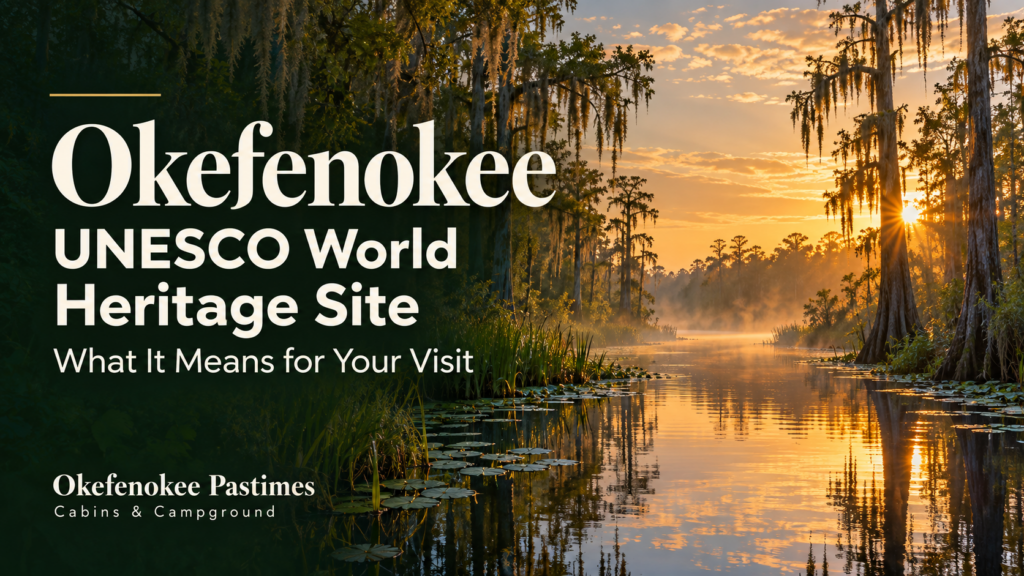
Folks in Charlton County have been saying it for generations, usually from a porch and usually while swatting at a gnat. The Okefenokee is one of a kind. Now the rest of the planet has gone and put that in writing. In July 2026, the UNESCO World Heritage Committee, meeting all the way over in Busan, South Korea, voted to inscribe the Okefenokee National Wildlife Refuge as a World Heritage Site. Somewhere in Folkston that week, somebody surely hollered the news across a gas station parking lot, and somebody else hollered back that they had known it all along.
The second fella was right. Anybody who has watched the sun come up gold over blackwater, heard a bull gator bellow low enough to rattle a canoe seat, or felt that first thick breath of swamp air glue a shirt to their back before eight in the morning already understood what the committee finally made official. Still, a designation this big raises fair questions for travelers. Does it change how the refuge works? Will it get crowded? Is it still the same old swamp? Here is what the Okefenokee UNESCO World Heritage Site designation actually means for a visit.
Georgia’s First World Heritage Site Was 44 Years in the Making
The push to get the Okefenokee on the World Heritage List started back in 1982, which means the paperwork alone is older than a good many of the folks now guiding boat tours out of the east entrance. It took more than four decades of scientists, conservation groups, local families, and plain stubborn swamp lovers to see it through.
The list of firsts that came along with it is long enough to make any Folkston native stand up a little straighter. The Okefenokee is Georgia’s first World Heritage Site, period. It is the 27th in the entire United States. It is the first site managed by the National Wildlife Refuge System to earn the honor, and it is the first new natural World Heritage Site added in the country in more than 30 years. That puts a swamp at the end of a two lane highway in southeast Georgia on the same list as the Grand Canyon, Yellowstone, the Great Barrier Reef, and the Galápagos Islands.
Locals are a little tickled by that company, to be honest. The Grand Canyon is lovely, sure, but it has never once offered anybody a sweet tea colored sunrise while a barred owl asks who cooks for you from somewhere back in the cypress.
What Put the Okefenokee on the World Heritage List
UNESCO does not hand these out for pretty scenery alone, though the swamp has plenty to spare. The committee recognized the Okefenokee as one of the largest and most intact subtropical freshwater peatlands on earth, and it holds the largest remaining undisturbed peat deposit on the North American Coastal Plain. That peat is the reason the water runs the color of strong tea, because tannins seep out of it the way flavor seeps out of a tea bag left steeping too long. It is also a kind of history book. Those intact peat layers hold an environmental record reaching back roughly 5,000 years.
The swamp is home to more than 1,200 species of plants and animals. Alligators stretch out on sun warmed logs, sandhill cranes trumpet across the open prairies with a rattling call that carries for a mile, and river otters porpoise along the banks like they are late for something. Carnivorous pitcher plants stand at attention in the wet prairies, and black bears move quiet as a rumor through the uplands. The refuge also protects stands of longleaf pine savanna, a habitat that has dwindled to less than 3 percent of what once covered the South.
On top of all that, the Okefenokee is the headwaters of two rivers, the Suwannee and the St. Marys, which wander off toward two different coasts. Standing on a boardwalk at dawn, with mist lifting off the prairie grass and the boards damp and cool underfoot, it is easy to forget all that still water is quietly on its way somewhere.
What Changes for Visitors, and What Stays Exactly the Same
Here is the good news for anybody worried the swamp went and got fancy. The refuge is still the refuge. It is still managed by the U.S. Fish and Wildlife Service, and the rules visitors follow, from entrance fees to boating regulations to overnight permits, are still set right here by the refuge. Nobody from overseas moved into the visitor center, and the alligators did not get new name tags.
What World Heritage status tends to bring is attention. Plenty of folks in town expect more travelers from across the country and around the world to put the Okefenokee on their list, and that is a fine thing for a small community that has always been proud to share its swamp. It does mean a little planning goes a long way. Permits for the interior overnight canoe trails and their wooden camping platforms were already competitive in spring and fall, and more interest means those dates may go even quicker.
What will never change is the swamp itself. The humid air still hangs warm and heavy, the cicadas still wind up like a far off chainsaw at dusk, and a windless morning on the Suwannee Canal is still so quiet a person can hear a fish break the surface fifty yards off. That kind of quiet does not care one bit what list it is on.
Planning a trip to see Georgia’s first World Heritage Site in person? Give Okefenokee Pastimes a call at 912-496-4472 or reach out through the website with your travel dates, and the folks here will gladly point you toward the best seasons, trails, and tours, then help line up a cabin, glamping tent, or RV site to come home to.
How to Plan an Okefenokee Visit Now That the World Is Watching
Go Early, and Go on a Weekday
The first hour after sunrise is when the swamp puts on its best show anyway. Light runs pink and gold through the Spanish moss, wading birds are already working the shallows, and the dew is still cool on the canoe rail. Weekday mornings keep the boat ramps and boardwalks feeling like they belong to just a handful of early risers.
Pick the Right Season
Fall through spring is the sweet spot, with cooler air, fewer bugs, sandhill cranes in the winter, and wildflowers popping up come spring. Summer brings serious heat and afternoon thunderstorms, and anybody who has felt a shirt stuck flat to their back by nine in the morning in July understands why locals head for the shade by lunch.
Book the Extras Ahead
Guided boat tours, kayak and canoe rentals, and overnight permits are all worth sorting out before rolling into town. It also pays to check current conditions with the refuge, since water levels can change which trails are open.
Treat It Like the Treasure It Is
World Heritage status is really just the world agreeing to help look after something special. Pack out every scrap of trash, give gators and nesting birds plenty of room, and never feed the wildlife. A fed gator is a problem gator, and that is a truth every Folkston kid learns right around the time they learn to ride a bike.
A World Class Swamp Deserves a Home Base: Okefenokee Pastimes Cabins and Campground
Okefenokee Pastimes sits at 28244 GA Highway 121, right at the main entrance to the Okefenokee National Wildlife Refuge. That means a visitor can finish a cup of coffee in a porch rocker and still be at the gate before the boat tours load up. The property has been family owned since 1980 and is veteran owned today, so it was welcoming swamp lovers long before the rest of the world caught on.
- After a long humid day out on the blackwater, the cabins offer cool air conditioning, a real bed, and a porch made for watching the light fade over the pines. Guests can choose a basic cabin or a deluxe cabin with its own private bath.
- Glamping tents. For folks who want to feel the swamp without sleeping on the ground, each glamping tent pairs real furniture and a comfortable bed with canvas walls thin enough to let the frog chorus drift right in.
- Campground and RV sites. The campground offers full hookup RV sites with 50 and 30 amp service and pull throughs up to 75 feet, so big rigs roll in without a fuss. Gravel crunches under the tires, the fire ring waits, and the cooler stays close.
- Room to roam. A stocked pond gives anglers a chance to wet a line between swamp trips, and hiking trails and an off leash dog area keep everybody, four legged guests included, stretched out and happy.
Then there is the restaurant, which is open to the public Thursday through Saturday from noon to 8 p.m. Burgers, Philly cheesesteaks, flatbreads, and wings come out hot, and a cold beer sweating on the table tastes about twice as good after a day on the water. Nobody has to drive back into town tired and hungry.
The Dark Sky Over Georgia’s Newest World Heritage Site
The UNESCO recognition centers on what grows, swims, and crawls in the Okefenokee, but locals will tell anybody willing to listen that the show does not stop at sundown. With so little light pollution for miles in every direction, the dark sky out here is something most city folks have simply never seen. The Milky Way stretches clear across the night sky like somebody spilled sugar on black velvet, and the stars stack up thick overhead.
On a cool fall evening, guests at the campground drift out to the fire ring after supper, pull a blanket tight against the chill, and tilt their heads back while the crickets take over from the cicadas. A barred owl calls from the tree line, a log pops and settles in the fire, and somewhere out past the refuge boundary the swamp keeps right on being one of the wildest places left on earth. Keeping it dark is part of keeping it wild, and it makes a fitting end to a day spent inside a World Heritage Site.
Ready to see the Okefenokee now that the whole world knows what Folkston always knew? Book a cabin, glamping tent, or RV site at Okefenokee Pastimes, and let a family that has called this swamp home since 1980 help put the whole trip together, from sunrise on the blackwater to stars over the fire ring.